
Three Votes is Unsatisfactory
As you know by now, the North Dakota Supreme Court ruled on November 21 that the abortion ban protecting preborn children that was signed into law in 2023 must be upheld. The catalyst for this case began with the “Trigger Law” put into place in 2007, which said abortions would no longer be allowed in ND after Roe v. Wade was struck down, as it was with the Dobbs case in 2022. However, as soon as that happened, pro-abortion groups took the state to court to block and overturn our law. They just lost!
The above paragraph is what I said in my email celebrating our pro-life victory on the day of the ruling. It truly was a hard-won and important victory for those of us fighting for life in our state. However, something bothered me. The ND Supreme Court could overturn our abortion laws that we’ve worked on for decades, with just 4 of the 5 Justices ruling in favor of the plaintiffs. Thankfully, only 3 of the 5 voted with the plaintiffs, so it failed, but that was just a one-vote difference. In other words, our entire protection of the preborn in ND came down to one vote. That kind of thin margin should worry all of us.
North Dakota, a pro-life conservative state, almost lost this critical battle. Importantly, it was not our legislature or governor who created this knife-edge win, but the judicial system. We publish legislative scorecards and/or can provide input on gubernatorial and legislative races, but when you ask us about judicial positions, we often can’t give you much guidance. We simply don’t have the resources to do the required research.
Justices serving on our ND Supreme Court must be fundamentally nonpartisan. Candidates for these offices are always very careful in their materials not to reveal any biases they might have. However, they are human and have their opinions and preferred way to interpret the law. The viewpoint of Justices on certain issues is not always obvious, but with this decision, it was. In a comprehensive way, it came down to allowing or prohibiting abortion in our state. How the Justices ruled was a pretty good indicator of their stance on the life issue – arguably the most important subject to many of us. However, keep in mind that Justices vote on more than one issue; there’s energy, farming, business, gender, religious freedom, and many more. So, while being a one-issue voter may be what you decide to do, it may come at a cost to you.
What can we do about it? First, let me state unequivocally what we should absolutely NOT do. We should never write angry or inappropriate emails to the Justices. We should never harass or threaten them. We should never take the issue into their personal lives. I can tell you with certainty that this type of behavior does not change minds, and in many cases, backfires, making the person even more firm in their viewpoint. But perhaps most importantly, there is absolutely no tolerance for this type of behavior as followers of Christ.
Back to the question, what can we do? We can vote and pray for those advising the governor’s appointments. Unlike SCOTUS, where their positions are for life, ND Supreme Court Justices are either initially appointed by the governor for a two-year term to fill a retirement or death during a 10-yr term of office, but then must run in the next general election to complete the term OR they are directly elected to a 10-yr term, which can then be extended 10 years at a time. Either way, it is presented to you for a vote. Of our existing Justices, some were simply appointed, while others needed your and my votes to assume their position.
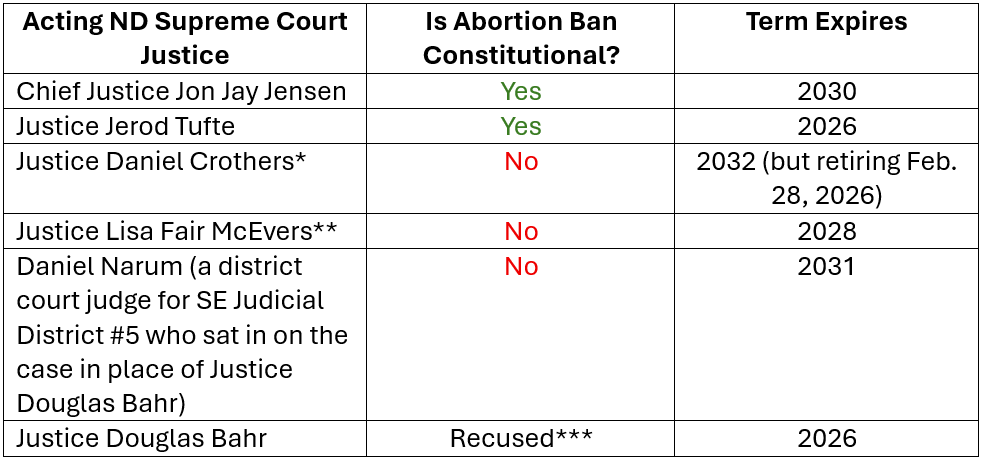
*Governor Armstrong will soon convene a committee to put together a list of candidates for appointment, according to the Governor’s Office.
**Recently elected to serve as Chief Justice, with her term beginning on Jan 1, 2026.
***Justice Bahr recused himself, given his prior work representing the state as Solicitor General in a Supreme Court case involving the clinic.
So, there you go. Please don’t misunderstand me – I don’t mean to be a wet blanket on the tremendous win we had with the recent ruling. It was huge! However, not unlike our legislative scorecard, we believe in accountability for all three branches of government: executive, legislative, and judicial. You can have an impact on how the highest court in the state is shaped!