
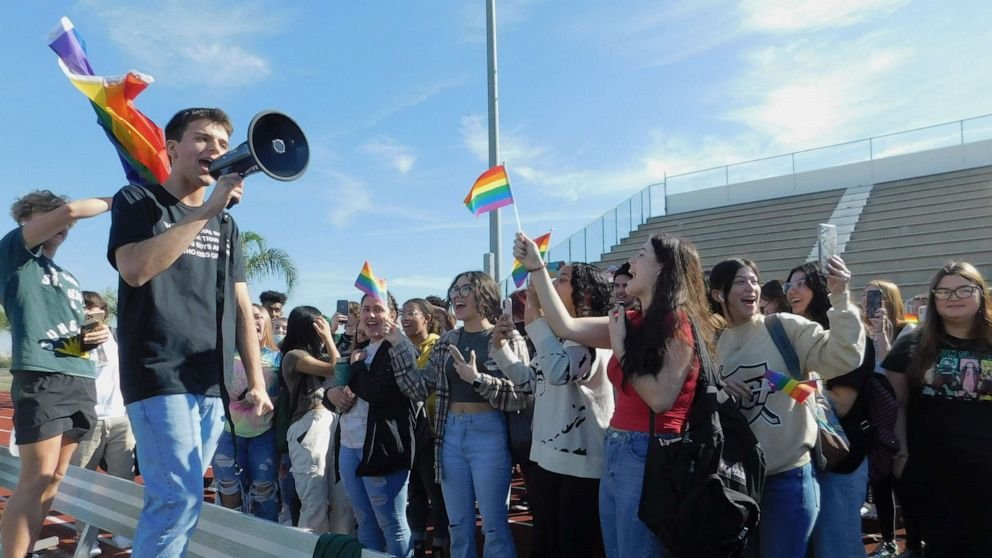
LGBT Discrimination and Bullying
There is growing validation of a type of oppression syndrome for those in the LGBT community. As a result, we as a society more and more simply accept that they are being discriminated against. We have a President, Federal and State agencies, large corporations (e.g., Disney, Amazon), and others with power, who insist that LGBT bullying and discrimination happen on a widespread basis, and as a result, put laws and rules and policies in place to eliminate and/or prevent it.
We see many examples of reinforcement that those in the LGBT community are not safe from “us”. Just recently, I was traveling and saw a rainbow background color police badge in a coffee shop window and it had these words: “SAFE PLACE, Report Hate Crimes, this location is a safe place for victims of hate crimes and harassment to call 911 and wait for police to arrive”. I wonder if they have a badge with a cross or unborn child on it to support those who are victims of hate crimes and harassment because of their faith or pro-life stance?
It's reasonable to wonder about LGBT discrimination specifically here in North Dakota. Organizations like the Williams Institute at UCLA School of Law have looked into this. The William Institute appears to be a respected and essentially pro-LGBT entity, that conducts surveys and research to, “ ensure that facts — not stereotypes — inform laws, policies, and judicial decisions that affect the LGBT community.” Looking at their facts, they found that if ND laws were put in place to prevent LGBT individuals from employment discrimination (as have been proposed at multiple state legislative sessions), the number of sexual orientation/gender identity employment discrimination complaints would increase state-wide. By how much you ask? By 3 complaints.
What about other types of discrimination, such as discrimination at our state's colleges and universities? The Williams Institute surveyed 629 LGBTQ and non-LGBTQ students across the nation on discrimination experienced at their four-year institutions. Let’s assume that the surveying was a 50-50 split along gender/sexual orientation lines, then roughly 315 survey participants would have been LGBTQ. If these 315 LGBTQ students were geographically spread across all states based upon state populations, then slightly less than 1 LGBTQ student was surveyed in ND. If we take yet another approach and spread those 315 LGBTQ respondents by state shares of LGBTQ individuals, it would mean just under 9 students were surveyed. Since the study found that 33% of LGBTQ students experienced bullying, harassment, or assault at college – that’s 3 college students in ND. While this should never happen, keep in mind that North Dakota has tens of thousands of students in 4-year institutions.
Does discrimination against LGBT individuals exist in ND? I’m sure it does. But it’s clearly far from any catastrophic situation we would be led to believe by our government and the media.
On the other hand, I can personally attest that bullying and harassment does happen on a significant scale to those of us on the other side of LGBT issues. People and organizations that try to protect your values and biblical foundations of marriage and sexuality, such as NDFA, are called homophobic, sent hateful and vulgar emails and letters, are cursed at, and more. Event organizers focused on gender issues are harassed, and social pressure is exerted so that businesses are afraid to sponsor and be associated with anything public proclaiming the truth about the LGBT movement. And this is not in California, New York, or Oregon. This is in North Dakota, folks.
So, where do we go from here? Let me be clear that I bear no ill will toward individuals of the LGBT community. They have been created in the likeness of God, as we all have, and everyone in their community has inherent worth and dignity. I may not agree with their lifestyle choices, but such is a pluralistic society. In fact, those on the opposite side of LGBT issues and I have occasionally briefly chatted at the Capitol when testifying. I actually appreciate these civil conversations and hope we can have more, so that I can better understand their perspective on issues and vice versa (yes, this is an invitation!).
In contrast, I am not as enamored with the leaders of the LGBT cause on the national level. They are the ones with wholesale social change at the top of their agenda, the ones pushing for federal laws that infringe on your and my rights, the organizations and individuals who are crying “victim” and influencing everything from national politics to the books in your child’s classroom. They are bullying corporations to adopt politically correct policies, lest they be shamed and have it impact their bottom line.
It is incumbent on us as Christians to do two things in these matters. First, never give up our values and our desire to preserve the fundamental biblical truths upon which this country was established. Second, never stop loving those who differ from us on this issue. I think we can agree that discrimination and bullying of LGBT community members should not occur in North Dakota. It may not happen to a great extent in our state, but I certainly hope and pray that it is never by you and me, followers of Christ.
Common FAQs about NDFA
I travel across our state and meet with constituents such as yourself whenever I have a chance. I love learning about you and your families, finding out your thoughts on policy issues, and providing information that you may need. In the course of my visits, I often get asked the same questions, so I thought I’d answer a few of those in this week’s email.
Q: What is the difference between North Dakota Family Alliance (NDFA) and North Dakota Family Alliance Legislative Action (NDFALA)?
A: Both organizations support the work we do and are under our “umbrella”, but given IRS guidelines, there are certain things NDFA cannot do, since it is a tax-exempt organization. NDFA can do advocacy, education, host conferences and rallies, get involved in critical issues in our state (e.g., Pledge of Allegiance by Fargo School Board) and so on, but it can’t really get involved in elections or do lobbying to any significant extent. As you might imagine, these are two really important things we undertake. As a result, we set up NDFALA which is classified as a 501(c)(4) by the IRS and is able to do this work.
Q: So should I donate to NDFA or NDFALA?
A: As described above, both organizations work on your behalf to integrate biblical principles into policy and defend your values here in ND. Right now, we need to prepare for the 2023 legislative session and make sure we have enough funds to keep us going during those months, working with the legislature on your behalf. As a result, donations to NDFALA are more urgent right now.
Q: What makes NDFA/NDFALA different than all the other organizations that defend our values and send me mail?
A: There are a few things that are unique to NDFA and our partner organization NDFALA.
We focus on North Dakota, and we typically get involved in national issues to the extent they influence our state. For donation requests that come in the mail, you can always tell it’s us by the buffalo logo (see above) or the words “North Dakota” somewhere on the donation return envelope address. Keep in mind that national organizations do important work as well, defending biblical values, so their presence is also of great importance. However, if you want to focus on laws and issues that directly affect North Dakota, NDFA and NDFALA have been created from the ground up to do precisely that.
All NDFA’s and NDFALA’s Board of Directors members are right here in North Dakota. They were born and have lived in ND their whole lives, so they understand you and your values better than anyone.
We are the official family policy council for our state. This means that we, like state family policy councils in 41 other states, have been designated as the lead on pro-family and pro-life issues by the Family Policy Council Alliance that serves as an umbrella group across the US.
We are one of the most highly respected Christian policy organizations in North Dakota. Ask around – our reputation for making a real difference protecting your values is well known.
Q: Are there any job opportunities to work for NDFA or NDFALA?
A: Yes. We are planning to advertise for a paid internship with NDFALA shortly. Watch for more information via email and on our Facebook sites. In addition, we are always looking for volunteers, particularly to help with events.
Q: You used to have dessert galas each year, but have now stopped. Will you once again hold these?
A: Yes, we will. Banquets will once again be held now that we are independent, and we are planning a full banquet in June of 2023. We already have a top-tier speaker lined up and you will really enjoy hearing this person present!
Q: Where are you physically located?
A: In Bismarck, but we travel the entire state, meeting with individuals. If you are interested in meeting or having us speak to a group or your church, give us a call or send an email and we’ll see if something can be arranged.
Q: How long have you been in existence?
A: NDFA was formed over 35 years ago (1987). We were part of the national organization Family Policy Alliance from 2016 through 2021, but are now once again a fully independent North Dakota organization.
Q: Can I reach out and discuss or ask questions about particular policy subjects?
A: Absolutely. That is one of the primary reasons we exist – to help educate North Dakotans on government actions/policies and provide insights on how they can best ensure we stay a state where faith, family, and freedom honor God. Simply call (701) 355-6425 or email us at mark@ndfamilyalliance.org.
Q: Aside from donating and voting, what else can we do to help you?
A: Pray! Prayer is powerful and we always need lots of it, particularly in the coming months.
In addition to these FAQs, I encourage you to check out the FAQs on our website for more information about us, and particularly to learn about and get involved in the political process here in ND.

The Red Folder and the Green Folder
My father was a pastor for 35 years, as I have mentioned in previous weekly emails. During his career he had mountaintops and valleys, just as we all do, but I think these highs and lows are often magnified for pastors. He put in long hours and worked hard (to the point of being hospitalized in his first congregation). He faced criticism, enjoyed validation and thanks for his work, saw people come to Christ under his preaching of the Word, and helped his congregations grow in their faith. As you can tell, I greatly admire what he did. But one day I came across something very odd.
When I was a teenager, I would sometimes help my father file things in his office (he was a “pile maker”), and one of those times I came across two thick folders: a red one and a green one. It was peculiar, since every other of his hundreds of folders were of the plain off-white manila variety. I started to go through these two colorful folders and was captivated. They were full of letters, handwritten notes, comments he wrote on scraps of paper, etc.
The red folder was the first I opened. As I made my way through it, I began to get upset. Here were notes and other correspondence that criticized my dad, told him how ineffective he was at his job, and sometimes even cursed at him. By the time I was halfway through the folder, I slammed it shut and had to stop reading. Then I turned my attention to the other folder – the green one.
As I began to read the contents of this one, it was like a breath of fresh air. In it were thank you notes for his hospital visits, heartfelt expressions of love from those who had come to Christ under his preaching, heart-wrenching thanks from families who benefited from his funeral for their loved one, and even notes from children drawing him walking back and forth as he preached (a signature move for him). The file was amazing, and I read through the whole thing. But at this point I was really confused; why the two folders?
That evening I asked him about them, and he seemed surprised I had read their contents, but he wasn’t upset. He simply said, “When I become proud of all I’ve accomplished in my career and begin to consider what a gift I am to everyone around me, I open the red file and start to read the comments. But when I’m down and discouraged and see no positive effects from my ministry, I open the green folder and read from that one.” That’s all he said, and we went back to watching TV.
Here I am, decades later. My father has passed into glory, and his legacy lives on in the lives and faith of thousands of people. I too am part of a ministry, and I pray that in some way, God will continue to use me to work out His purpose. I try to remember Colossians 3:23-24 – Whatever you do, work heartily, as for the Lord and not for men, knowing that from the Lord you will receive the inheritance as your reward. You are serving the Lord Christ.
We all get praised and criticized during our lives, sometimes legitimately and sometimes without basis. However, I believe that God calls us to be faithful, and not swing too much on the feelings and words of man. However, that’s easier said than done. We are still human and will always be influenced by those around us.
I have my work materials upstairs these days. Business cards, brochures, stationery, envelopes, etc. However, there are more important items than that. You will also find two folders, a red one and a green one. They are there for the mountaintops and the valleys.

Toxic Masculinity
You’re probably thinking, “are we really wading into this swamp?” The answer is, yes. Although you may have come across the term toxic masculinity on social media or in some recent publication, is it a real thing or just a meaningless term? Let’s unpack it a bit.
What does toxic masculinity mean, as used by today’s culture? Given the many definitions out there, I attempted to cull the characteristics most often associated with this concept. Toxic masculinity generally refers to cultural pressures or norms exerted on men that are associated with:
Hatred/contempt/prejudice toward women
Violence and abuse of women
Bullying
Homophobia
Aggression
Support of patriarchal concepts
Stoicism
I think it’s safe to say that the first few of these concepts are not supported by biblical principles. I’m not going to go into an exegesis on the role of men in God’s creation mandate or the biblical relationship of a husband and wife, but things such as hatred of women or abuse are simply wrong. The same with genuine bullying.
But what about concepts as we move down that list? We may not agree with those who have an LGBT lifestyle, but given our values, it does not justify hatred or prejudice against them as individuals.
Does aggression by men generally fall into the category of toxic masculinity? Patriarchal concepts? Is it appropriate for men to hold all the power and women to be excluded? You have to acknowledge that even male stoicism can be bad when it leads to something as simple as avoiding annual physicals (Come on guys, I dislike them too, but we’re all getting older).
I believe that all these characteristics and actions can be indicators of toxic attitudes held by men. Any one of them may be toxic, but is it a case of a “necessary, but not sufficient condition”? In other words, perhaps one action such as these has to be present to identify toxic masculinity, but can you label something as toxic masculinity when observing only that one action? In this regard, I’d like to point out three observations concerning the concept of toxic masculinity.
Actions are not People: Take the homophobia concept, which is often used to illustrate toxic masculinity. If a bill is proposed which would single out LGBT persons as a special protected class of people, I will testify against it, and be branded homophobic, even if it would create huge inequities towards other members of society. Does that mean I’m homophobic and exhibiting some form of toxic masculinity? No. It means I’m trying to avoid reverse discrimination against men and women who do not identify as LGBT.
Context Matters: If a male refuses to follow instructions from his female supervisor, does that mean he is exhibiting toxic masculinity and hatred of women? Perhaps, but it is also possible that his supervisor is verbally abusive towards him or intentionally gives him the worst projects. Does that justify his behavior? No, but it clarifies that it’s not toxic masculinity at work here.
It’s Not Always the Action, but What Motivates It: Motives matter. For example, stoicism by a dad may appropriately be intended to help give confidence and coping skills to his family as mom dies from a lingering terminal disease. The act of a father teaching his son how to defend himself from a male or female attacker is not teaching aggression towards women. It’s not toxic masculinity.
Nothing I’m saying is meant to ever justify abuse, violence, bullying, or prejudice against women or others. What I am pointing out is that life is complicated, and reducing an observed action to a convenient and socially acceptable concept is an easy way out. The notion of toxic masculinity is being used as a scapegoat concept, and it creates the risk that masculinity as a whole will be painted with a broad brush. Masculinity is not fundamentally toxic.
I see toxic masculinity being blamed for a lot of actions that may have deeper roots, such as alcoholism, drug use, anger control issues, or being abused as a child. Let’s treat the cause and stop calling it toxic masculinity. Let’s treasure and love the women in our lives, as commanded by our Lord, and leave aside the convenient and socially approved labels that are often used to simply create distraction from the real issues at hand.
For the men and women of North Dakota,

More Thoughts on ND Education
I’ve been thinking a bit more about education in North Dakota, and in particular, how this education reflects your and my values. This applies to everything from kindergarten through higher education. What got me thinking about the importance of this subject was something that happened while I was driving home from Fargo.
I was on I-94 making my all-to-common trek back to Bismarck and was in the process of passing a school bus full of children. They looked to be second/third graders. As I passed, I saw lots of smiling faces pressed up against the glass and hands waving excitedly at me. They were wanting a response from me, but more importantly, what I saw was innocence.
Contrast this to a recent event, where innocence was betrayed. A fifth-grade child in the Fargo School District was pulled out of class and disciplined for using the wrong pronoun for a classmate. That’s right – it happened here in North Dakota. Some of you may downplay this, recognizing that the Fargo School District is on the more liberal side of the spectrum for our state. So, let me give you another example.
Take the University of Jamestown, part of a very conservative community, where their “commitment to the Christian faith encourages an atmosphere of self-discipline, responsibility, and concern for the continuing growth of the individual.” For Black History Month, they highlighted Marsha P. Johnson on Facebook, a transgender prostitute. They chose her over such individuals as Dr. Martin Luther King Jr., Booker T. Washington, Supreme Court Justice Thurgood Marshall, and other prominent black leaders, who they never bothered to mention on the Facebook page during Black History Month. I truly love the University of Jamestown, but this made me very sad.
Or take the recent school board elections. In Grand Forks there were 23 candidates for 5 open positions, and in Fargo 15 candidates for 5 positions on their school board. Why so many candidates? Because parents are frustrated with authoritarian and unresponsive administration of our schools. A number of these candidates in both races supported yours and my values, and said as much in their campaigns, but do you know how many of them were elected? None. Do you know how many of the candidates supported by the powerful Fargo and Grand Forks teachers’ unions made it into office? 80%.
So, what’s going on here? Simply put, you and I don’t have a say into these educational institutions. Sure, they would argue that we simply need to attend school board meetings, contact them about issues, or sit down and talk about what’s bothering us. That’s well and good, and I encourage you to do that, but what if there is nobody on the other side of the conversation taking it seriously, or if they simply never acknowledge you or respond? What change can be made then?
As parents, you try to teach your children many lessons – some stick, some don’t. One that we’ve tried to instill in our children is this. Even if you think you will lose a battle over your beliefs, you still fight. In spite of opposition, in spite of insults, lies, or other tactics. You take the high road, but never give in. God does not call us to be successful, but to be faithful.
The mental picture of those children on the bus has stayed with me. Their enthusiasm and innocence is something I will not soon forget.
So, what did I do? I smiled and waved, and then drove home thinking about what more we can do to support our kids.