

Shadows on the Wall
This past Sunday we celebrated Easter, which is truly a time of celebration for Christians around the world. We attended our church, Evangel, and heard an uplifting message and call for all those who were not saved to commit their lives to Christ. During the message, our pastor said something that particularly caught my attention, in large part because it directly related to my work over the past three months. He said:
Jesus died, and He rose again. And here’s why. Not so all of us would get a ticket to get out of here as things get more crazy, but so that we, His people, would be empowered by His Spirit to be His witness on the earth. That we would make a difference in the world around us. So following Jesus is not an escape method, it is an engagement call, to be a part of our world…
I wholeheartedly agree. As Christians, we sometimes feel that it is OK to live a life separate from the “evil world”. Many over the centuries have held this view. Not surprisingly, we at NDFA do not.
Some of you may remember studying Plato’s Allegory of the Cave in school. In short, he suggested that in many ways, we are like prisoners chained to a wall who can only see our shadows. Because that is all we see, that is reality for us, even though it is not actual reality.

The picture you see, above, is from that same Easter service. It is the shadow of a guitarist performing on stage during the worship portion of the service. That shadow is not the guitarist. It cannot actually play the guitar, interact with our world, or do the other things we can do as real humans. The shadow cannot make a difference in the world around us.
What did make a difference in our world was the music the actual guitarist played on stage during the worship service. He was real. He was praising God with his talents. He was touching lives for Christ.
While I don’t necessarily agree with Plato’s allegory, I acknowledge that sometimes we get fixated on the shadows in our lives. We get caught up in our minds with things that don’t exist or tell ourselves that nothing we do really matters in the long run. What does it matter if politicians vote one way or another? Why should I bother with biblical values when they don’t deal with my world, but are just shadows of the past? They are just ephemera with little real relevance for me.
If that’s your perspective, I’m sorry that I have to be the one to break it to you – we are not shadows. Christ, who was very real and walked among us, made it clear that what we do as living human beings matters in His Kingdom. We’re not like the shadow of that guitarist; we can impact our world and we have been commanded to do so.
Does that mean you have to become a politician? Probably not. Does it mean you have to testify in front of a legislative committee, even if you become a bundle of nerves when speaking in public? No, you don’t. But like our guitarist, you do what you have a talent for; that thing God has enabled you to be really good at.
I can’t play the guitar, and it’s probably for the better, given the sounds I’d be subjecting my family to. But I can support that guitarist, by singing along, thanking him when I see him after the service, and financially supporting my church.
In the case of NDFA, we have the talent to work with legislators and help get bills passed into law. To quote our pastor, we do not want to get a ticket to get out of here as things get more crazy, but be empowered by His Spirit to be His witness on earth. No, we most certainly are not seeking that ticket. At NDFA, we want to get even more engaged as things get more crazy in our world!
NDFA exists to be the voice for you and your values in the policy world. We seek to ensure that what we do is a witness to those around us, and we thank God daily for the privilege to represent your deeply held beliefs. What can you do? You can help us by writing that email to your legislator, praying for our work, and financially supporting us.
Let us be your guitarist up on the public stage of politics. Pray that we are empowered by God’s Spirit and act as His witness, as we play your music across North Dakota.

A Response to the Fargo Public School Board Position on HB 1522
North Dakota Family Alliance firmly believes in a pluralistic nation and state. One where different viewpoints can be held and all can exercise the freedoms we hold so dear, subject to the rule of law as determined by a democratic process. The Fargo School Board seems to believe otherwise, given their recent statement that they will actively disobey the recently signed and enacted House Bill 1522.
At the board’s May 9 meeting, Superintendent Dr. Rupak Gandhi stated that they would defy the new law and cited transgender young people’s suicide rates and lack of parental support among the reasons. We certainly want the best for every student in North Dakota, including the estimated 1.2% of young people aged 13-17 in our state who identify as transgender. But what about the other 98.8% of students?
The issue is that Dr. Gandhi and the rest of their board believe that HB 1522 causes harm, while we would contend that it prevents harm. As Governor Burgum stated numerous times, North Dakotans need to start by actually reading the bill. Here is a link, in case you are unfamiliar with its contents.
As is apparent, it is not some draconian legislation aimed at hurting transgender young people, but quite the opposite. It is meant to prevent harm to all the other students, parents, and teachers in North Dakota. The major elements of the bill state: 1.) teachers and students cannot be forced to use preferred pronouns, 2.) restrooms are only to be used by those of the same biological sex and, 3.) a school and its staff cannot withhold or conceal information about a student's transgender status. Looking at the bill from a somewhat more conceptual perspective, here are the key ideas embodied in the bill that seem to be getting the most opposition and media attention.
Choice: The bill states more than once, “…may not adopt a policy requiring or prohibiting…”. Nobody is limiting the use of pronouns. It merely protects students and teachers from being forced into using a student’s requested pronoun. Teachers and students do not leave their First Amendment rights at the front door of the school.
Parental Involvement: The new law states in multiple places that things may only be done, “…with the approval of the parent or legal guardian…”. In other words, parents are the first and final decision makers when it comes to their child’s education. We agree. This may be shocking to some in the more “progressive” educational establishment, but that’s how it is. In fact, it was reinforced this session with the passage of HB 1362, affirming parental rights in education and many more areas. It’s clearly important to legislators, and by extension, the North Dakotans they represent. Imagine if it was proposed that parents be prevented from seeing their children’s grades. Both parents and educators would quickly agree it was a bad idea and should not happen. This bill prevents withholding information from parents about something even more important than grades – a child’s preferred gender. Believe it or not, parents can actually help their children work through feelings of gender dysphoria.
Safety: The new law prevents transgender students from using restrooms that do not coincide with their biological sex. We heard over and again during testimony this session that transgender individuals do not pose a physical danger to members of the opposite biological sex. Whether or not this is true, those who are not transgender will quickly see an opportunity to capitalize on social permissiveness and pose an actual physical danger to other students using restrooms. Further, what is often omitted is the emotional and psychological danger people of the opposite sex can pose to other students by sharing a bathroom. It is not difficult to imagine a scenario where a young girl is traumatized by having a biological boy expose himself to her in a school restroom. This bill prevents that from happening.
The new law based on HB 1522 addresses choice, parental involvement, and safety for all students. Some might argue that these no longer exist for transgender students under the new law. However, the law allows a transgender student to be identified by another name or gender. It allows a transgender student to use a restroom that conforms to their biological sex or a family-designated bathroom. It allows a child to present as transgender.
All of this does not even begin to address the blatant disregard for the law that the Fargo School Board and its Superintendent have modeled for their students. They have effectively said that it is perfectly fine for students to ignore laws they disapprove of. Does that also apply to their students if they disagree with school rules? What if parents decide to ignore school district mandates and regulations? And these do not even have the weight of law. Do you see how this can quickly spiral out of control?
In the wake of this controversy, the Fargo School Board has invited students in other districts to join their district in its enlightened position. Considering that their position is unlawful, the attraction might be a bit less enthusiastic than they expect, but we will see. Is it some sort of virtue signaling? Or maybe it’s just a poorly thought-through position that endangers the stability and support for their school district? Only time will tell, but one thing is for certain. It doesn’t represent North Dakota values, and the last time I checked, Fargo was still part of North Dakota.

Some Thoughts on LGBT Issues in North Dakota
Our organizational position is that we believe marriage was created by God and is the basis for our society. We believe human sexuality was designed and intended for our good within the bond of a committed, lifelong marriage between a man and woman. As a result, we advocate for policy that actively supports biblically based marriage, and we oppose policy that encourages individuals to pursue alternative definitions of marriage, to the extent it undermines traditional marriage values and endangers the rights of others.
The fundamental difference in how we judge human sexuality and marriage is certainly at the crux of these issues, however, there are additional issues with the LGBT agenda. While we support equal rights for members of the LGBT community, we oppose preferential treatment. The push today is for including gender in everything from birth certificates (which, by definition, makes no sense) and educational materials, to state constitutions and much more. North Dakotans most certainly showed the state this session that we are frustrated with liberal ideology and don’t want it to take over our state. We elected a huge number of Christian conservative legislators last year, and this session with all its gender bills was the result.
I have a personal aversion to the constant pressure to use more and more pro-LGBT terminology; it is slowly changing our language in the direction of that social ideology. I don’t refer to any group of people as LGBTQ, or LGBTQ+, and certainly not LGBTQQIP2SAA (yes, that’s a real abbreviation). Cisgender was not used or understood by most people a few years ago, but now many of us accept when we are labeled that way. Never forget that words create worlds.
It bothers me that the LGBT community has appropriated the meaning of the rainbow. For those of us who believe the Old Testament story of Noah, using the rainbow for LGBT pride is pretty far off the mark. More generally, if I were to tie a rainbow ribbon to my suitcase so I can spot it on the conveyor belt at the airport, it’s not a statement in support of LGBT rights, but simply means that a bright, multicolored ribbon is easier to spot (and also that I really should have purchased a suitcase in other than black). Unfortunately, nobody is sure what the rainbow means these days, and I find that regrettable.
Now, before you think I’m just in a bad mood and picking on the LGBT community, let me stop and pivot to the second point: individuals who are part of the LGBT community and/or defend its ideals. First, they have been created in the image of God and possess inherent worth and dignity, regardless of whatever beliefs they may hold. They do not deserve derogatory terms, discrimination, or aggression for holding their beliefs. Our mission is not to “drive them out of North Dakota” any more than we make it our mission to drive out people who commit adultery, get DUIs, or are atheists. That’s not how our pluralistic society works.
So then how should we reconcile opposing viewpoints, respect for individuals, and appropriate responses? I believe the answer begins with common ground. Let me explain.
Representative Josh Boschee is the House Minority Leader in our ND Legislature and has been in office for the past decade. Josh also happens to be openly gay and is obviously a strong supporter of the LGBT viewpoint. He and I disagree about a lot of things – I’m sure they include some of my comments at the beginning of this email – but that doesn’t particularly bother me, and I’m guessing it doesn’t bother him much either. They simply reflect our different points of view. This is why when I came across House Bill 1533, I was intrigued.
Our organization works on bills that uphold faith, family, and freedom from a biblical foundation. HB 1533 did just that. It prevented “abusive litigation“ against survivors of domestic violence/abuse. In other words, let’s say a wife was beaten by her husband, pressed charges, and the courts ruled in her favor. End of story, right? Not with abusive litigation. Under this scenario, the husband files case after case against the wife, stretching out over years in some instances, draining her finances, tying up our court system, and making her relive and remember the abuse for years, when she should be starting her new life. HB 1533 was a good piece of legislation that would stop this from happening. Representative Boschee was the sponsor and it had nearly all Democrats cosponsoring.
I called Josh to talk about it and indicated that our organization would like to get behind this bill, and he was happy to have us on board. We did support it, with testimony, alerts to all of you, and work behind the scenes. I found it somewhat ironic that when a legislator who is possibly one of the most liberal in the ND legislature, teams up with one of the most conservative Christian organizations doing policy work in our state, a bill becomes almost unassailable. HB 1533 passed the House by a 91-3 margin, the Senate with a unanimous 47-0, and Governor Burgum signed it into law on March 22.
We are all extremely happy that this bill made it into law and that it will hopefully further protect vulnerable North Dakotans from abusive partners. However, the striking thing that singles out this bill for me is what led to this unlikely team that got it into law. Here’s the rest of the story.
In 2017 I was new to the legislature, and one day during the beginning of session I caught up to Representative Boschee walking down the hallway in the Capitol and introduced myself. I said something to the effect of, “We both know we’re going to disagree on perhaps 95% of all the issues that come up, and we will certainly fight for our respective positions. However, what I’m most interested in is that 5% where we agree and can work together.” He concurred.
Josh, it took six years and many bills, but we found a bill that fits into that 5%. I’m really glad we did, and I hope we find many more in the years to come.

282
Numbers are interesting things. They can often be solutions to mathematical problems or perhaps dollars on a financial statement. Sometimes they represent concepts with deeper meanings, like the numbers 12 or 7 in the Bible. However, occasionally they are no more than a tally of something. That’s what 282 is.
I have written 282 weekly emails since I began writing them in September of 2016. We get positive feedback from many of you on the emails, even if I sometimes wander into philosophical musings a bit too far. However, somebody recently noted that my emails have changed over time. That made me curious, so I went back through some of the earlier ones. He was right, they have changed.
In some sense they’ve become more informed, now that I’ve been doing this for a few years. They’ve changed as different policy issues rise and fall in the public spotlight. I’d also like to think that my perspectives have matured and are a bit more refined today than they were a number of years ago. However, the one thing that hasn’t changed is precisely the attribute they were never intended to have: they are personal.
Weekly emails for most state Family Policy Councils (FPCs) give updates on key policy issues, ask constituents to get engaged in some specific manner, ask for donations, and so on. It was recommended to me when I started that they be between 250 and 300 words, since the thought was that people won’t read longer emails. Since I’m a stubborn Dutchman, I decided to ignore all this time-tested advice and do something different. To the credit of Family Policy Alliance, of which we were a part at that time, they never told me to change my approach (perhaps it was like watching an accident in slow motion).
From the beginning, I decided to instead write from my heart about the subjects that mean the most to me in the political world, and to speak as a husband, father, North Dakotan, and more. Not to sound like a political analyst you might watch on FOX. Not to write constant urgent emails that begin to sound like shouting after a while. You know what I’m talking about – we all get those emails.
Instead, I have all along simply wanted to have a conversation with you. People prefer being talked “with” rather than “at”. And in case you haven’t noticed, these emails are also far from 250-300 words long.
But here’s the irony in all this. You have provided more positive feedback than most FPCs typically get. We know that you open these emails at amazing rates when they show up in your inbox. Basically, your interest in our weekly emails has scored off the charts. Whatever quirky, introspective, or humorous thoughts I may be relating, you seem to be willing to give them a listen, and I am deeply thankful to you for that.
North Dakotans are common-sense sorts of people. I’ve used that sentence many times in my testimony this session, because it’s true. It encourages folks to step back, take a breath, and say, “You know what, this is nonsense. We need to put a stop to this”. I have tried to speak to legislators in the same way I write these emails: as a father, husband, and fellow North Dakotan.
I will continue to pen these weekly emails from the heart, with common sense perspectives, and try to keep them from devolving into narcissistic ramblings. That may mean you’ll have to read about hamsters, shadows, our dog Annie, or how to make a family soup recipe, but hopefully I can convey some deeper truth there as well. Something that reveals how we might live in this amazing world, politics and all, and glorify God as we do it. Thanks for listening.
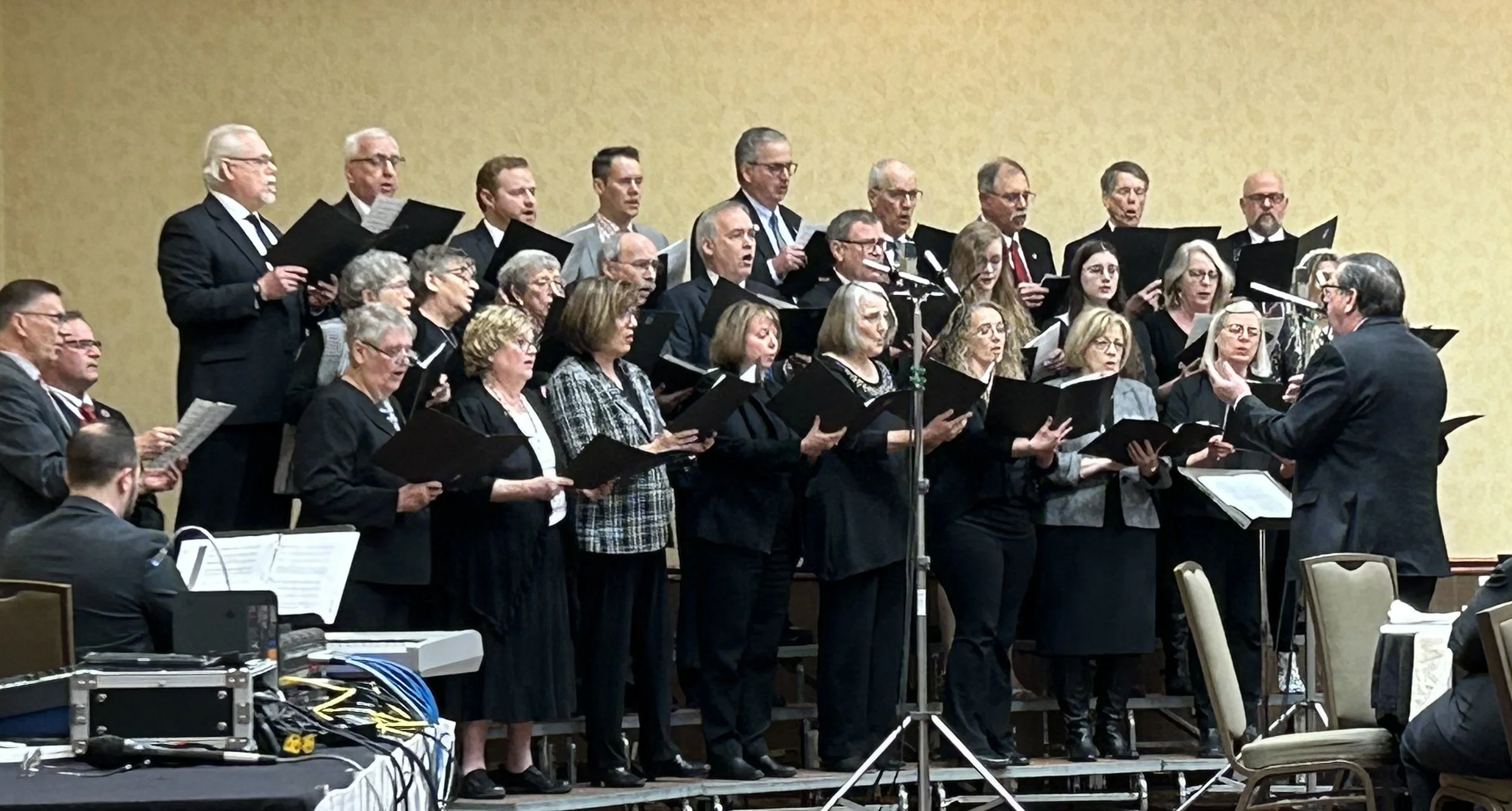
Take My Hand
Last Friday was the Governor’s Prayer Breakfast. It was well attended, as usual, and I would like to thank Alan Klein for once again organizing a great event. Our speaker was former Congressman Mark Siljander, who had an amazing story of Christ’s love and grace in the difficult circumstances of his life. In addition to his keynote address, Governor Burgum spoke, there were various legislators who read passages of scripture and prayed, and much more. However, for me, while the whole morning was very meaningful, the part of the event with the greatest impact was not any of these. It was the choir.
I like almost all types of music, from hymns to rock, Country to EDM (those over 50 are excused from not knowing what this is), RAP to Gospel, and Alternative to Pop. Nevertheless, there is just something about choral music that seems to speak to me more than other types. Perhaps it’s from singing in various choirs over the years, or maybe because I have a wife and children who have a similar history of choral participation and who love the music.
The choir was made up primarily by legislators, but there was even a member of the Governor’s staff who participated. The group was directed by Senator Robert Erbele, who did a great job conducting them.
So why my fixation on the choir, particularly when there were arguably other very laudable parts of the prayer breakfast? Because of what I saw, what I heard, and what they embodied when combined.
If you look at the picture of the choir, above, you’ll see men and women, Republicans and Democrats, liberals and conservatives, freshman legislators and those who have held their seats for decades. The choir was a melting pot of North Dakota political leaders. From my perspective, it represented the very best of who we are as a state. It gave a voice to all. That was the first part – what I saw.
Then there was what I heard. One of the songs they sang was "Take My Hand Precious Lord", a familiar gospel hymn for most of us. It is a very moving song and speaks to life’s hardships and how we long to rest with our Lord.
Now combine what I saw with what I heard. There you had legislators singing the same song, many of whom were about as politically different as you can imagine. Yet, there they stood, side-by-side singing:
Precious Lord, take my hand
Lead me on, let me stand
I am tired, I'm weak, I am worn
Through the storm, through the night
Lead me on to the light
Take my hand, precious Lord
Lead me home
Chorus, Take My Hand, Precious Lord, Thomas A. Dorsey
While this song is often used at memorial services, I think it also in a very real way described what those legislators were likely feeling.
After three months of unbelievably long days, intense analysis into hundreds of bills, innumerable debates and hearings, and being tested spiritually every day, I know with certainty that they were justified in saying, “I am tired, I'm weak, I am worn”. However, more importantly, they were asking in one voice for the Lord to take their hand and lead them. Despite all the differences, debates, or political leanings, they wanted the same thing; the Lord to help lead them.
And I have seen the Lord leading them; leading to shape the future of our state. He is helping them to see the right courses of action to ensure that His will is done, sometimes in amazing ways. Whether or not they always recognize it or even like it, God is giving them what they in some way are asking for in the song – direction in how to lead all of us.
I would ask that all of us pray for our legislators as they embark on this final leg of the legislative session. Let’s ask God to continue to lead them and keep them strong. Let’s also pray for Governor Burgum. He has many important decisions to make in the next few weeks, and we need to keep him and his staff in our prayers, so that they may make the right decisions for North Dakotans, and honor God in the direction our state should move.