

It's All About Stories
We all love stories. Stories can be entertaining, teach a lesson, carry on family traditions, and do many more things. Stories can change our lives, sometimes in even greater ways than experiences can. When each of our kids left for college, I gave them an important piece of advice – I told them to “make stories”. And they did. However, I fear that the power of stories is sometimes lost on us, and that’s a shame.
When I worked at World Vision, their tagline was “Orange is the color of hope”, which was inventive and played off their orange logo (somebody tapped the marketing dept. for that one). However, I learned that while it was a good tagline, hope was not conveyed to child sponsors through a logo, but through stories. When sponsors heard stories about the living conditions of children in other countries, their family hardships, their dreams, or how donor contributions helped, the stories made it come alive.
Stories work the same way in families. My father, as a small boy growing up in The Netherlands, had some great stories, from saving his sister who fell into the canal by pulling her out by her hair, to narrowly escaping the Nazis many times during World War II. His stories always intrigued and delighted me, and I am thankful that some of them have become part of the “body of work” in our family. To be fair, not all his stories were so idyllic.
There’s one story I’ll never forget. Their pastor visited their home, putting his wooden shoes outside on the doorstep, and my young father proceeded to relieve himself into the wooden shoes from an open second floor window. As you may recall, God called my father into the ministry later in life, so there is more than a little irony and humor in that story. It’s interesting how it goes from being a story of rebellion, to one showing God’s plan for his life; a story about an incorrigible child, to a story about a pastor who led many to the Lord over his ministry. Don’t ever tell me God doesn’t have a sense of humor.
In a similar vein, although thankfully less extreme, his son has stories, such as cutting down a tree outside his dorm building with a steak knife and dragging it inside to use as a Christmas tree (I’m sorry Calvin College – I’ll pay to have a new one planted if you’d like). Or stories of him walking security rounds through dark campus buildings with his girlfriend. I have to admit that I can’t guarantee all the doors were 100% secure on some of those nights, but you have to acknowledge that kissing on the darkened stage of the college’s concert hall is pretty romantic. That girl later married me, so I think the college will forgive me at this point.
Stories tie us to the past, present, and future. They tell of the difficult times we go through as families and God’s provision and care for us. They tell of ways in which we supported each other when things became tough. Stories are about laughter and, unfortunately, sometimes stories are about loss and pain. Stories tell our lives in compelling ways, similar in many ways to the oral tradition used among the Israelites for centuries, telling of God’s wonder and might.
Years ago, our family started a list – a list of stories. Each entry on the list is simply one sentence that reminds the reader of a particular family story. As our kids grew, Ruth and I would tell the associated stories about our life and that of our parents, and we would tell them over and again. Our kids thought we were losing our minds and forgetting that we already told them, but there was a method to our madness. We wanted to make sure that someday when we are gone and they and their children want to remember the funny, heartbreaking, or poignant stories of our family’s life, they will simply need that sheet to trigger the memory of a story, and will then be able to retell it from the many times they heard it. Our life stories are part of God’s majestic handiwork, and we need to give witness to that.
In a similar way, the history of our country is a set of stories. From our split from England, to centuries of innovation and God’s blessing, and up to today. The stories were shaped in large part by political forces, from our Constitution, to laws that created an environment ripe for growth, so that we could finally become the preeminent world power in a mere 200 years. Our country may not last forever, but while it does, we owe it to our children and grandchildren to use public policy to ensure that the stories they tell will be good stories, and not bad ones. They should be stories of standing for our deeply held beliefs, protecting our children, preserving our families, and defending our freedoms. In short, stories of bravery.
Lord willing, someday Ruth and I will have a chance to tell our grandchildren the most important stories that were part of our lives. We will tell them the good and the bad – the stories of pain, laughter, forgiveness, and Christ’s redemptive love for us. I don’t plan to tell them the Christmas tree story, except as a cautionary tale. Kissing at night in the darkened concert hall? That one I might tell.
The Mathematics of Prayer
I’m sitting in Babb’s Coffee House in Jamestown as I write this email. I have a mango Italian soda next to me and, not coincidently, I just found out I don’t like mango Italian sodas. The place is a cool and trendy establishment and is abuzz with groups of people eating their lunches, others like me working on their computers and tablets, and of course lots of University of Jamestown students, despite the academic year not starting for a few weeks. There are also the employees working at breakneck speed to fill orders. There is the small young lady who yells out “Tom” or “Julie” or “Samantha” at a volume that I imagine carries on the air currents and eventually settles in Bismarck or Fargo. So, what does this have to do with prayer, you might ask?
Many years ago in college I was inundated by mathematics, and I wasn’t a big fan. I actually sort of liked calculus, but disliked algebra with a passion. Interestingly, it was the exact opposite for my wife Ruth – she liked algebra and hated calculus. Regardless of one’s affection or distaste for math, you have to admit that it is immensely helpful in understanding the world around us and has everyday applications in more ways than you can count. But math and prayer? Stay with me.
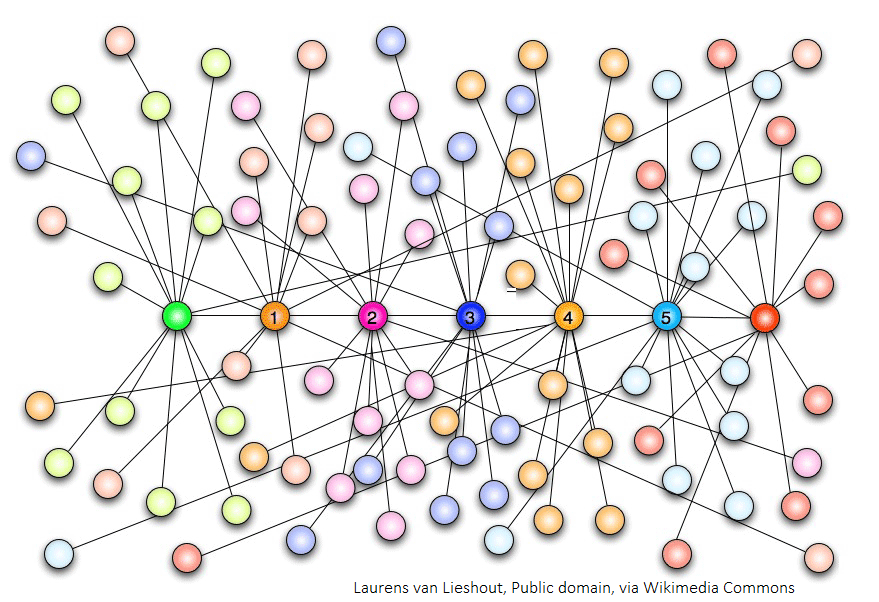
Back to the coffee shop. What I see is a multitude of people living their own lives, yet intricately connected to one another. There is a relationship between me and the employee who took my order, with the young lady who yelled my name, the toddler in the booth in front of me who keeps turning around and smiling at me, and on it goes. It’s a living organism in many ways. In a perfect world you could describe all these relationships perhaps using algebra or calculus, but the formulas would be pretty intractable. However, the most important mathematical concept about prayer is really simpler than that.
What happens mathematically when I connect with 3 people in that coffee shop, each of them connects with 3+ friends, and so on? You get exponential growth. And that’s how prayer by a body of believers works.
When I ask for prayer from my family for NDFA, my three other family members pray. They also then often ask for prayer from their friends, partners in prayer groups, fellow church members, or other Christians they know. I can see this picture in my head of all these nodes connecting to each other and creating a larger and larger canvas of prayer. And it’s a beautiful thing.
The power of one person praying can be an incredible thing – I in no way mean to understate its importance. However, the power of hundreds or thousands of people praying is almost beyond comprehension. We have been given an unbelievable gift to talk with our Heavenly Father, but I believe we often undervalue it.
When we were in the process of starting NDFALA, the entity that does much of our legislative work, I was concerned about raising enough donations for the demands of the coming legislative session and I asked for prayer. A good friend of mine and pastor gave me this advice. He said, “NDFALA doesn’t need prayer just to raise this money, but needs prayer as its foundation”. I took his wise words to heart and try to remember them during our busy workdays.
We at NDFA have truly felt called to embrace and focus on prayer’s importance in all our lives, and so we have decided to host a one-day prayer conference in September. It will highlight prayer for our families, education, government, churches, and the business community, and it will be held at the Heritage Center on September 21. We will email you more information and how to get tickets soon.
There is no substitute for prayer in a Christian’s life. We ask you to make it a priority and to remember the mathematics of prayer – it is much larger than just you. Who knows, with enough prayer I might even learn to like mango Italian sodas, although that might take a lot of prayer.
Corporate Accountability
Billy Graham once said, “Give me five minutes with a person’s checkbook, and I will tell you where their heart is.” While I can think of a few exceptions to this, I agree that your finances usually follow your priorities. As it says in Matthew 6:21, “For where your treasure is, there your heart will be also”. If you think that racing motorcycles is a priority, then your credit card will probably have lots of charges for motorcycle parts suppliers. If it’s quilting, then the local fabric store will figure prominently in your bank account. But here’s the thing, sometimes we think our finances are following our values, but they really are not.
Let me provide an example. There is a proposed piece of legislation called the Equality Act which creates nothing close to equality but elevates sexual orientation and gender identity as a protected class along with existing protections for things such as race, color, religion, sex, and national origin. It states,
“This bill prohibits discrimination based on sex, sexual orientation, or gender identity with respect to businesses, employment, housing, federally funded programs, and other settings.” Equality Act Summary
The Equality Act would conflict with many of the gender laws ND passed this past session, and it explicitly states that the Religious Freedom Restoration Act (RFRA) is not a defense against the law. We just passed RFRA in North Dakota and it protects our religious freedoms in a comprehensive manner (think Jack Phillips the baker who refused to bake a cake for a same-sex wedding). Thus, the overall take on the Equality Act is that it is bad for those of us with traditional pro-family values.
So, who would support this harmful infringement on our freedoms and religious liberty? Reportedly, over 500 corporations have publicly supported this law. That’s fine, you might say, then we will let our dollars do the talking, in line with Billy Graham’s quote. Easier said than done.
Perhaps you don’t feel like cooking tonight, so maybe ordering a pizza is the plan for dinner. You go online with your HP laptop, pull up Google, and find the information for Dominoes. You call them up and place your order using your iPhone on your Verizon cell plan. At the appropriate time, you give the Dominoes employee your Citibank Visa or Mastercard or your Discover card to pay. After a really long wait (you’re hungry!), your pizza is delivered by a guy wearing Levi’s jeans and a J.Crew t-shirt who drives a Ford Focus. You grab a Coke from your GE refrigerator, settle into your couch from Ikea, and watch some Netflix while eating your pizza.
Congratulations, you just directly or indirectly supported at least 13 companies that have explicitly indicated their support for The Equality Act. Frustrating, isn’t it? I suppose if you wanted to live off the grid in a cabin in the woods, you might be able to avoid supporting something directly contrary to your family values on this issue. Just make sure you don’t buy any of your tools from Home Depot.
From a practical perspective, it is very difficult to identify and avoid corporations that support terrible legislation like the Equality Act or that espouse values directly opposed to those of you and your family. Most of us know that finding substitutes for Disney, Target, and CVS is a good thing to do, but it is clearly broader than that. So, can we really vote with our dollars or not?
We can – just ask Budweiser. It is the easiest when we know a corporation has taken a consistent and outspoken position against our values. It took longer than it should have, but our family no longer watches Disney movies or Disney+ shows, no longer shops at Target, and recently started using Gateway Pharmacy for our prescription needs. However, a lot of corporations have been unwittingly ignored by us on the ramifications of their stance, and what I linked to was their position on only one LGBT issue/bill.
So, what are the other options if voting with dollars won’t entirely do it? The other most impactful option is public policy. It means using political and legislative avenues to ensure your values are represented in North Dakota, and more broadly in our nation.
This is why North Dakota Family Alliance and our sister organization North Dakota Family Alliance Legislative Action work so hard to defend your values in the state legislature. In fact, during the 2019 legislative session, we specifically fought and succeeded in helping defeat two bills that would have done something virtually identical to the Equality Act at the state level – enshrine some combination of gender and sexual orientation as a protected class (House Bill 1441 and Senate Bill 2303). And we not only fight against this type of legislation at the state level. We regularly join with the other 40 Family Policy Councils around the country to battle legislation similar to this at the national level, by submitting legal briefs and working with the U.S. Supreme Court and lower courts indicating our opposition to these types of laws.
The other way you can use public policy to defend your values is by contacting your senators and representatives at the state and national levels. For example, it takes a very quick phone call to Senators Hoeven and Cramer and Representative Armstrong to indicate your opposition to the Equality Act. Here is their contact information.
To recap, what tools are in your toolbox to ensure your values are heard at the national and state levels on an issue like the Equality Act? In no particular order:
Contact your congressional and state legislators (upper right corner of the page).
Support organizations like NDFA who continually fight for your values at all levels of government.
Whenever possible, stop your patronage of companies that oppose your values and support companies that uphold your values.
So now you definitely have some tools in your toolbox which can make a difference. You can protect your family’s values in concrete ways. That is one of the reasons why we are here – to give you these tools so that your voice can be even louder. Plus, I guarantee you that our tools are not from Home Depot.
Brothers and Sisters in Christ
Today I am writing to you from the 2023 Family Policy Council conference. I am so excited to be attending again, reconnecting and exchanging ideas with my colleagues from across the nation. I don’t go to conferences very often, since I’ve found over the years that many are not particularly productive, so going would not honor being a good steward of your financial support. However, this one is different.
This year we have Family Policy Councils (FPCs) from 40 states represented, the most recent being Oklahoma, who just last week became the official FPC for their state. Each state has their own organization, similar to North Dakota Family Alliance, and there is a vetting process before you are recognized as the state’s FPC. We want to ensure that we are all Christian organizations and that we share the same basic values on key issues. We always have a great time of Christian fellowship and comradery at these conferences. To gather with these leaders is truly a privilege.
One particular benefit we receive by connecting with other state directors is sharing best practices. They often face some of the same challenges we face in North Dakota and we can provide guidance on how to best tackle an issue. Similarly, they share model legislation to show what worked in their states and to give us ideas on how to turn challenging issues into successful legislation. And it doesn’t stop there. We also discuss ideas about church engagement, conferences, how to help new legislators integrate their faith with public policy, and much more. Finally, we share challenges and victories from each of our states. I think they will be hard pressed this year to find another FPC that worked harder or got better results than NDFA, and it's all because of you!
However, the most important aspect of the conference has always been the unity of faith. Here are 40 state directors who share the same Christian beliefs. They value families and want to ensure that pro-family and pro-life legislation is passed, as we do in North Dakota. Our unity of faith is what binds us together. Whether I’m talking to someone from Washington, Georgia, or Nebraska, we all share the passion to make our states ones where God-honoring faith, family, and freedom flourish.
Finally, the one thing we always agree on is that we can’t do our work without the help of our state partners, such as yourself. If you want to help us advance our pro-life and pro-family values in North Dakota, I encourage you to become a ministry partner. There are many ways to do this.
It may mean responding to our action alerts, praying for our ministry, or helping financially support our work (or all three!). It’s great to receive the good ideas and help from our brothers and sisters in other states, but we can only be successful and fight the good fight here in North Dakota with your help. Thank you for your continued support for us as we advance our Christian values at the Capitol in Bismarck and across the state!

The Road Less Traveled
We have a framed poster hanging in our house that depicts a well-known image Christ spoke about – the narrow and wide gates and their associated roads (Matthew 7:13-14). The poster is a very old and fascinating depiction of that bible passage, and it’s a good reminder of the decisions we make in life that take us down one path or another.
One of the interesting features of the poster is the list of building titles, each representing sins or virtuous actions along life’s journey. Many reflect a time gone by. Some of the sins include buildings such as a movie theater, bar, loan shop, and dance hall. On the narrow road, the buildings include a deaconess institution, Sunday school, and of course a church. It shows the wide road ending with a city on fire; the narrow one has a heavenly city at its terminus.
The poster seems quaint to us today, but the basic choice is still the same, even if the buildings have changed. Perhaps today’s buildings on the wide road might be named abortion clinic, LGBT indoctrination school, religious discrimination club, or something similar. On the narrow road may be the church, Christian home, or crisis pregnancy clinic.
Regardless of language, we still make choices each day. The small ones – essentially each step on one of those roads – matter. As Paul Tripp put it, "The character of a person's life is shaped in 10,000 little moments. You carry the character formed in the mundane into those rare consequential moments of life."
So, our journey matters, but we are not traveling the road of life alone. C.S. Lewis says in his book, The Weight of Glory:
…the dullest and most uninteresting person you talk to may one day be a creature which, if you saw it now, you would be strongly tempted to worship, or else a horror and a corruption such as you now meet, if at all, only in a nightmare. All day long we are, in some degree, helping each other to one or other of these destinations. It is in the light of these overwhelming possibilities… that we should conduct all our dealings with one another, all friendships, all loves, all play, all politics.
You see, whether we help each other to one or the other of these destinations is of supreme importance. I find it hard to reconcile the Great Commission with helping someone dance their way down that wide road.
We have similar choices in the political arena. We have many opportunities to take the easy, wide road. To not get involved with more controversial topics. To let certain values slip a bit when societal pressure hammers us. To not always hold legislators accountable for their actions. However, at NDFA we do not believe that is the way we should conduct ourselves if we truly believe biblical values are to be defended and advanced in ND. We must be bold, and stay on the narrow road.
For precisely that reason, we helped support bills this session dealing with protecting life, fighting social engineering of gender and sexuality, preserving religious freedom, protecting women and children, and much more. It is also for that reason you will be receiving our 2023 Legislative Session Scorecard shortly. We don’t take the easy road, and neither should our legislators if they stand for pro-life and pro-family values. By the same token, those that do protect biblically based policy should be recognized and celebrated by all of us for their faithful stance.
Like so much of life, public policy comes down to doing things the right way, which is often the hardest way, or doing them the wrong but much easier way. It comes down to that poster with the two roads. At NDFA, we always want to be traveling on the narrow road, right by your side. Thank you for allowing us to be your traveling companion.